Thursday, February 4, 2021

Ain’t No Valuation High Enough to Keep the Market from Lovin’ Growth Stocks!


Ain’t No Valuation High Enough to Keep the Market from Lovin’ Growth Stocks!https://millervalue.com/opportunity-equity-4q20-letter/


Miller Opportunity Equity ended the year on a strong note, notching a 35.4% (net of fees) gain in the quarter versus the S&P 500’s 12.15%. This brought the 2020 annual return to 37.8% (net of fees), more than doubling the market’s 18.40% return. The gains were driven by a strong market recovery from the COVID crash earlier in the year, along with good old fashion stock picking. Performance in the quarter benefited from a rebound in “value” more broadly. Over the year, we benefited from diversification between different types of values: longer-term, more growth-oriented compounders as well as classic value holdings.

The only bad news about such strong returns: they aren’t sustainable. We just made in a quarter what we might expect to earn over numerous years. Huge market bursts can’t endure forever. Many take this line of reasoning a step further, projecting a major pullback. We disagree. We think the market can continue to be stronger than many expect providing a window to earn strong returns. We estimate the portfolio currently has greater than 60%1 upside to our calculation of its intrinsic value offering strong return potential.

Market pullbacks happen frequently, and no one can consistently predict them accurately. We wouldn’t be surprised by a modest one after such a strong move. However, we believe we are in a bull market and the market can continue to move higher driven by a continuing economic recovery, attractive equity valuations relative to bonds and over a decade of underinvestment in equities relative to bonds. There are two key points we think aren’t well understood. First, this economic hit is more akin to a natural disaster than endogenous economic malaise. This has important implications on many levels. First, the sudden dramatic nature of the pandemic caught everyone’s attention garnering unprecedented resources and support. The Fed expanded its balance sheet by $3T over a few months. During the financial crisis, it took more than 5 years for a comparable dollar expansion. Likewise, we’ve seen two rounds of fiscal stimulus totaling just shy of $3T and with a Democratic-controlled Congress, more appears to be on the way. During the 2008-09 financial crisis, total stimulus was just over $1T, so a fraction of the size. In addition, corporations, universities, and the broad population have marshaled unprecedented levels of resources to combat the problem.

During and after a natural disaster, the economy behaves differently than a normal recession. The economic hit is sudden, dramatic, and extreme, but so is the ensuing recovery. After Hurricane Katrina, employment fell off a cliff but it had fully recovered a couple years later. It took nearly a decade after the financial crisis for unemployment to reach pre-crisis levels. So far, employment trends are tracking much closer to Katrina than the financial crisis.

The pandemic, lasting many months, is more prolonged than a typical disaster, but the natural disaster analogy implies a quicker and stronger recovery once we reach the other side. A combination of greater infection rates and vaccine distribution will help get us there over the coming months. This implies gains could continue to be faster and stronger than many expect.

Second, we are in a bull market. This definitely isn’t news to anyone, but I think people underappreciate the importance of the point. My partner Bill Miller writes fantastic market letters (link to recent one here). For roughly the past decade he’s started with this statement. Why? It provides the broad context you need to know how to behave optimally.

The market’s reaction function (how prices respond to news and events) differs completely in bull markets than in bear markets. How can the market mostly ignore protestors storming the capital and temporarily disrupting the smooth transition of power? A bull market can look through to economic implications, while a bear won’t.

Investors often focus on the problem of losing money during pullbacks, but over the past decade investors’ biggest mistake has been missing out on massive gains due to overwhelming risk aversion. Likewise, bubble fears caused many people to exit the market in 1998, years before the top. One of Bill’s best all-time moves was his near-perfect timing when exiting technology stocks in 2000. He pulled this off partially by being a keen observer of the market environment.

Bull markets typically don’t peak during a strong economic recovery with accommodative monetary and fiscal policy. We think it’s optimal to play offense in a bull market driven by a recovering economy. If this changes, we can adjust accordingly.

Our favorite relevant quote from Sir John Templeton (which we repeat A LOT) is: “Bull markets are born on pessimism, grow on skepticism, mature on optimism and die on euphoria.” Understanding sentiment in this way helps us frame the opportunity set along with the risks. Greater pessimism implies higher future returns, while the opposite is true of euphoria. The depths of panics, like March 2020, provide the best buying opportunities. When no one sees risks, run for the door. So where are we now? It’s hard to be precise but we’re somewhere in the later stages of the bull market. While this implies we are closer to the end, it’s important to note that the latest stages of bull markets typically generate some of the best returns. Lazlo Birinyi is a market strategist with an excellent long-term investing record. His team divides bull markets into four stages (similar to Templeton): reluctance, consolidation, acceptance and exuberance. The first (reversal off bear market lows) and last (euphoria kicks in) stages offer the best returns. They think we might be somewhere in the acceptance phase. I like to joke with Bill about how he’s usually right, just sometimes early. During the financial crisis, he shorted oil based on his view that it was economically sensitive and the world was falling apart so the price shouldn’t be rising. He nailed it fundamentally but that didn’t stop the price from continuing its rapid ascent before falling apart. A few years ago, a client asked about risks. Bill replied bonds were expensive and if stocks rose to comparable levels, it would produce massive gains but then it would be difficult to make money anywhere. That scenario seems more likely now. If true, the good news is there’s still a window to make nice returns. The bad news is that it might be followed by some ugly times. We will do our best to adapt as circumstances change.

In more growthy areas of the market, euphoria seems to abound. We aren’t optimistic about the long-term return prospects for certain growth names where elevated prices make it increasingly difficult to meet market embedded expectations. We know from history that the very best companies drive the overall market’s returns. When the rarefied company, like an Amazon or Apple, sustains high growth rates for extended periods of time, high multiples on current revenues and earnings are justified, while still offering attractive returns. But most companies priced to achieve this type of growth fail to do so. Currently, many growth companies trade at significant premiums to even Amazon’s historical valuations, outside of the peak of the tech bubble.

The market is pricing more and more companies as if they will achieve Amazon or Apple type growth. We estimate current market expectations imply Apple-level growth for Peloton and Amazon-level growth for insurance company Lemonade. In the past few weeks alone, we’ve heard numerous companies pitch themselves as the Amazon of this or that area. There are far more Amazon aspirants than actual Amazons.

We recently exited Peloton because of heightened risk of falling short of elevated expectations, along with our belief that other names offered better opportunities. We bought Peloton in the low $20’s right after the IPO believing it was a misunderstood disruptor with a powerful brand that could change the way large numbers of people exercise. We still see significant potential for Peloton to grow the business over the long term.

However, we estimate current market expectations imply Peloton will grow at a slightly greater rate than Apple did2 from a comparable level of revenue for the next 22 YEARS. Very few companies have a shot at this type of performance. Work by Michael Mauboussin3 shows companies’ competitive advantage periods (the period over which it can earn excess returns) average 10-15 years. Alternatively, Peloton will need to grow topline 38% annually over the next 10 years to justify the current price, well ahead of Netflix’s 28% topline growth from a comparable revenue level. Not a bet we want to make.

Part of our initial bull case on Peloton compared the brand power to Apple’s. But the analogy only goes so far. Most people can’t put down their phones. On the other hand, most can’t get off their duffs to exercise! Peloton is an amazing company, but we don’t want to bet its Apple-level amazing, especially as extremely tough comps in the back half of 2021 could present near-term risk.

A couple points: not all growth companies have elevated expectations. Despite the significant moves up we still believe Farfetch, Amazon, Stitch Fix, along with the other high growth names we still own are undervalued. Our primary job is to do the company-by-company work of sifting through market expectations relative to our assessment of fundamentals. We make bets when we think those two sides of the equation are out of whack. We think through the opportunities relative to the risks. We believe our flexibility to migrate as the opportunity set dictates offers us a significant competitive advantage relative to investors forced to stay in a more restricted area.

Since we own some high growth names, we often get asked if we are truly a value manager. The answer: absolutely! We only purchase a name is if we think it’s a good value. Likewise, we use valuations to make sell decisions (which has not helped us in this market where no valuation is too high for beloved companies!). We do believe this discipline will pay off over time.

Many people equate low accounting-based metrics (P/E, P/B, etc) with good value, but that’s simply not the case. Low accounting metrics are markers of low expectations, but fundamentals must outperform those expectations for stocks to do well. The value of any investment is the present value of future free cash flows. Those may be difficult to forecast, but they will drive the value of any investment. We spend our time understanding business values in different scenarios and what historical precedents imply on the likelihood of outcomes. We want a favorable skew between returns in the base or best case scenario relative to the worst case.

As in everything with markets, value investing evolves over time. I recently read a post saying the founder of value investing, Ben Graham, would have been very uncomfortable with Warren Buffett’s method of projecting earnings to derive a value. It’s certainly true that the cone of uncertainty widens with time. Ben Graham himself spoke of this in The Intelligent Investor:

The better a company’s record and prospects, the less relationship the price of shares will have to their book value. But the greater premium above book value, the less certain the basis of determining its intrinsic value – i.e., the more this “value” will depend on the changing moods and measurements of the stock market. Thus, we reach the final paradox, that the more successful the company, the greater are likely to be the fluctuations in the price of its shares. This means in a very real sense, the better the quality of a common stock, the more speculative it is likely to be.

So relevant to our current environment! Innovation and growth have fueled returns, but that’s led to valuations of those companies disconnecting dramatically from current revenue and earnings streams. As long as belief states about future growth prospects hold, it’s not a problem. With disappointment comes great loss.

We can look back at the great Nifty Fifty growth stocks of the 70s to understand they actually weren’t all that overpriced, but that didn’t stop them from suffering a huge crash. Likewise, buying Amazon in 1999 was a great move long term but that didn’t protect you from losing a ton of money over the next couple years. While we don’t see near term risk to growth stocks broadly, we do think there’s a good chance this euphoria won’t end well. In the past, it’s taken a recession to end these sorts of moves. A significant move up in rates is another threat to long duration assets.

We try to think through these risks carefully. We manage them in the portfolio through security selection and portfolio diversification. We also want to understand these darling companies well enough to take advantage of any opportunity that arises from price weakness.

The key behind all value approaches, though, is a strict reckoning between what you are paying and what you are getting. That’s our lifeblood. Most sell-side analysts don’t even run long term discounted cash flows, and I don’t remember ever seeing a model that looks at numerous future scenarios. I love that because it means our approach isn’t in high demand from those on the buy side either. This means it’s a potential edge versus others.

We really love the current portfolio. It trades at a steep discount to the market (roughly 12x next 12 months earnings versus the SPX at 23x4). Even with our higher multiple growth names, we think the portfolio is very attractively valued even on near-term metrics. We constantly work to see if we can improve our risk-adjusted returns and we continue to find attractive investment opportunities. I will highlight a couple examples.

Desktop Metal is a name that made it into our top holdings at the end of year due to strong performance since our purchase at the end of the third quarter. The company is a second-generation industrial printing company led by a great team. It came public through a merger with a SPAC led by Leo Hindery, Jr. who we’ve known from his successful history at Telecommunications, Inc (TCI) where they excelled at capital allocation. One of the unique benefits of structure is that it helps us get access to unique opportunities. Here, we were able to invest in the PIPE (private investment in public equity) to take the company public based on industry relationships.

Desktop Metal is early in its commercialization, but we think the company has great potential over the next five years with a stellar list of customer partners and potential applications. We bought on the deal at a $1.8B enterprise value or 6.7x the EBITDA management estimates it can earn in 5 years before any acquisitions. For a company capable of growing at such high rates (triple digits for next couple years), with a great business with high moats and a fantastic team, this was a great deal. It’s doubled since the deal. This is a great example of an undervalued, long-term, growth-oriented opportunity that we were still able to source in this market.

In the squarely value camp, we bought Norwegian Cruise Lines in the fourth quarter. The sector has obviously been one of the hardest hit by COVID with business shut down. It should be one of the biggest beneficiaries of a normalization due to vaccines and infections helping us reach herd immunity at some point. As we got clarity around vaccine efficiency and potential timelines for disbursement, it enabled us to analyze the ability of cruise lines to make it through and what the potential balance sheet and earnings power might look like on the other side. We think Norwegian is worth somewhere in the $40s with a good ability to withstand the crisis. We think the recovery in travel is more likely to beat current recovery expectations than it is to fall short, setting up a nice risk-reward.

We also bought Diamondback Energy. For the first time in decades, we find energy to be quite attractive. Companies are finally focusing on cash flow and returns. Diamondback is a low-cost shale producer that screened well on a number of metrics we pay attention to (dividend yield, free cash flow yield, discounted cash flow, and insider buying). They recently added ROIC to their management incentive compensation. They plan to continue to pay down debt and maintain the dividend. The company is obviously levered to increasing oil prices.

Green Thumb, another new name, is a cannabis company that we have watched for a while. The company is the best capital allocator in the space with a focus on profitable growth in limited license states, while also building national brands. We believe there’s a long growth runway due to state adoption driven by budgetary needs. We believe that GTBIF is undervalued based on their current licenses alone, while state expansion is virtually guaranteed.

Another name we’re very excited about is WW (formerly known as Weight Watchers). We’ve followed it for a while. CEO Mindy Grossman, joined in 2017, is excellent. While the company has looked cheap in the past, we think the digital transition has reached an important inflection the market is not reflecting. We expect improving revenue growth and margin expansion and believe the stock can double.

Lastly, we added a small position to Netflix after the disappointment following 3Q results. Overall, it’s getting more difficult to find investment opportunities in the very high growth areas that meet our standards for attractive value. On the other hand, we continue to find opportunities in more value-oriented areas of the market. We would expect the portfolio to migrate in this direction.

We appreciate your interest in Opportunity. We continue to work hard to earn attractive returns for our investors and thank you for your support.

Samantha McLemore, CFA


Strategy Highlights by Christina Siegel, CFA

During the fourth quarter of 2020, Miller Opportunity Equity returned 35.4% (net of fees) compared to the unmanaged benchmark, the S&P 500 Index, return of 12.1%.

Using a three-factor performance attribution model selection, interaction, and allocation effects contributed to the portfolio’s outperformance. Farfetch, Stitch Fix Inc., Uber C32 1/2022 options, Desktop Metal Inc., and Precigen Inc. were the largest contributors to performance, while Alibaba Group Holdings, Vroom Inc., ADT Inc., Canada Goose Holdings, and Lennar Corp. were the largest detractors.

Relative to the index, Opportunity was overweight the Consumer Discretionary, Financials, Health Care, Energy and Industrials on average during the quarter. With zero allocation to Real Estate, Utilities, and Consumer Staples, the portfolio was dramatically underweight these groups and more moderately underweight the Communication Services, Information Technology, and Materials sector.

We added six positions and eliminated six positions during the quarter, ending the quarter with 44 holdings where the top 10 represented 40.9% of total assets compared to 27.4% for the index, highlighting Opportunity’s meaningful active share of around 88.1%.

Top Contributors

  • Farfetch Ltd. (FTCH) continued its climb in the quarter, returning 152.7%. The company really took off following the announcement of a landmark global partnership with Alibaba, Richemont & Artemis. The deal gives FTCH access to Alibaba’s platform and its 757M customers while also starting new relationships with Richemont’s brands. The agreement will provide an infusion of $1.15B from their new partners to help them grow out the platform in China and beyond and aligning the incentives of all parties. Later in the quarter, Alibaba’s President Michael Evans joined the board of directors. The company also announced another strong earnings report. For the 3rd quarter, the company posted revenue of $437.7M versus consensus estimates of $369.8M. Gross Margins were above expectations at 48% against estimates of 45%. The result was the company had an Earnings Before Income, Taxes, Depreciation, and Amortization (EBITDA) loss of just $10M, versus expectations for a $22M EBITDA loss in the quarter. Gross merchandise value also beat expectations coming in up 60% versus expectations for 40-45%. The company guided to EBITDA profitability in the fourth quarter ahead of expectations.
  • Stitch Fix, Inc. (SFIX) climbed an impressive 116% in the quarter following the release of their Fiscal Year (FY) 2021 first quarter results. Revenue for the first quarter came in at $490M, beating estimates of $481M. Gross margins were higher than anticipated at 44.7% versus expectations of 43.6% and adjusted net income coming in at $9.54M versus expectations for a -$18.5M decline. The company provided stronger than expected full-year guidance, with revenues of $2.05-$2.14B, relative to $2.01B estimates. Stitch Fix finally announced their new CFO, Dan Jedda, who joins the company from Amazon.com. The company is beginning to see uptake in their “direct buy” offering which is allowing them to expand their products to customers that are not current Fix members allowing them to expand their total addressable market. The shift to online purchasing has also further supported the company’s strong momentum.
  • It was a busy quarter for Uber Technologies (UBER) who took off in the quarter following the passing of Proposition 22, their ballot initiative that allows them to classify their drivers as independent contractors and not employees. The company also reported 3Q results that was largely in-line with expectations. Adjusted net revenues of $2.81B was slightly below expectations of $2.82B with EBITDA of -$625M coming in slightly worse than expectations for -$623M. The company reiterated their expectation that they will reach EBITDA profitability at some point in 2021, as their Eats business continues to see strong growth as the pandemic continues. The company announced the sale of ATG, their self-driving car unit, to Aurora for $4B, while investing $400M in the business and holding a 26% share of the combined entity. This was followed by the announcement of the company selling Uber Elevate, their air taxi business, to Joby Aviation with Uber investing an additional $75M in Joby. The company’s acquisition of Postmates closed in the quarter and Mexico’s antitrust regulators approved Uber’s acquisition of Cornershop, the Latin American grocery delivery company. The company also announced a joint-venture with SK Telecom, to create a South Korean taxi-share company investing $150M in the start-up.

Top Detractors

  • Alibaba (BABA) had quite the quarter rising up to a high of $317 in October only to end the quarter down 20% after the delay of the Ant IPO and the announced investigations by the Chinese government into monopolistic practices at the firm. There was additional pressure on the stock as the US House of Representatives passed a bill that threatens to delist Chinese companies from US exchanges unless US regulators are able to inspect their financial audits within three years. During the quarter, the company increased their share buyback program from $6B to $10B. The company report second quarter FY21 results that were largely in-line with expectations. The company reported revs of Rmb155.1B (USD 23.9B) slightly beating consensus of Rmb 153.9B (USD 23.7B) and adjusted EBITDA of Rmb 47.5B (USD 7.3B) versus 41.3B (USD 6.3B). The company maintained full year guidance for revenues of Rmb 650B (USD 100.3B).
  • Vroom, Inc (VRM) continued to decline in the fourth quarter following the additional equity raise they did at the beginning of September at a price of $54.50. The company reported 3Q results above consensus with total revenue of $323M versus $311M estimated, gross profit of $25.4M versus $22.3m estimated leading to Adjusted EBITDA of -$35.7M ahead of expectations of -$42.1M. The company guided for revenue of $372M-$414M with the midpoint slightly below consensus of $398M with gross profit of $24-28M versus $27.7M estimated and adjusted EBITDA of -$52M to -$44M versus consensus of -$42.8M. The company is beginning a slow roll out of its last mile delivery and is working to build up its infrastructure to be able to handle the higher demand it is seeing. During the quarter, the company announced the purchase of CarStory, which does AI powered analytics and digital services, for $120mm in a deal split between cash and stock.
  • ADT Inc. (ADT) declined 3.5% during the quarter. The company reported strong 3Q results, which showed continued net subscriber growth with record customer retention (attrition of 12.9% versus 13.5% last year). The company reported revenue of $1.30B versus consensus of $1.25B with EBITDA of $564M versus $524M expected. The company updated full year guidance to revenue of $5.20-5.35B versus consensus of $5.24B and EBITDA of $2.15-2.225B versus $2.144B expected and free cash flow (FCF) guidance of $650-725M (raising the lower end by $25m from previous guidance). The company has set 2H21 as the time frame to launch their professionally installed and co-branded offering with Google (ahead of mid-2022 guide) and they announced that they are developing an ADT-owned, next-gen, residential technology platform allowing them to use their own proprietary software.

Thursday, January 28, 2021

A Discussion with John Hofmeister: Where Are Oil Prices Going?

https://www.youtube.com/watch?v=XTub0DSRlPo&feature=youtu.be 


Please join Ed Butowsky as he sits down with John Hofmeister, the former president of the Shell Oil Company and an expert in the oil industry, to discuss how geopolitical events impact the price of oil. Please remember, the direction of oil prices is a crucial component to the value of your overall

Wednesday, January 27, 2021

Meet The New Market Makers They're young, they're rich, and they couldn't care less about Graham & Dodd

https://archive.fortune.com/magazines/fortune/fortune_archive/2000/02/21/273891/index.htm  


Meet The New Market Makers They're young, they're rich, and they couldn't care less about Graham & Dodd. But they're the ones driving those insane tech stocks, and they're not going away.
By Nelson D. Schwartz

(FORTUNE Magazine) – There are about 20 minutes to go before the stock market closes, and I'm standing next to 24-year-old Adam Mesh in the sprawling offices of Tradescape, a Manhattan day-trading firm. "Hey, check out PLUG," Mesh yells out. Overhead, on one of Tradescape's ubiquitous TV monitors, CNBC's Joe Kernen is talking up Plug Power, a fuel-cell company that Mesh and the other twentysomething traders here have never heard of before today.

On his multicolored computer screen, Mesh is watching PLUG, already up $15 to $53, suddenly begin to surge again. He jumps in, buying 500 shares at $55. About a minute later he gets out at $58. But PLUG is still soaring, so Mesh gets back in, this time at $60. I look around at the other traders squeezed shoulder to shoulder in Tradescape's offices, and on every screen the ticker PLUG is flashing, its shares furiously moving higher.

"What the heck is this company?" I ask. "It's PLUG," Mesh says. Yeah, I know that much. But what does it do? "I don't know," Mesh responds, without looking up. "Power, I guess." I decide to let the issue drop, and with PLUG now about to close at $79, the question of what the company does seems pretty irrelevant. In a rapid bout of buying and selling, Mesh trades nearly 10,000 shares of PLUG in the few minutes I stand behind his desk, making $20,000 in the process. It's been a good day for Mesh, but for some traders it's been even better. "I made a honey," one guy calls out, using trader slang for $100,000. "Can you believe this?"

Clad in a scruffy old T-shirt and in desperate need of a shave, Mesh is an unlikely mascot for the new world of Wall Street. But at a time when day traders, Internet message-board prowlers, and plain old folks with Ameritrade accounts are increasingly driving the action, it's Mesh--not Peter Lynch or Warren Buffett--who typifies today's investor. They're the ones who are moving the stocks that you hear about on CNBC and at cocktail parties, those names that jump 20% a day, sometimes 200%.

Nowhere is this new reality more obvious than among Nasdaq's highfliers. Forget Cisco or Microsoft or Oracle. Those hot stocks of yesteryear are now practically blue chips. No, we're talking about the real occupants of the Nasdaq stratosphere, stocks like JDS Uniphase or PMC-Sierra or BroadVision. All tech companies, and almost all linked to the growth of the Internet, these stocks have proven irresistible for mutual fund managers and day traders alike, and they've amassed huge valuations in recent months. JDS Uniphase is now worth over $60 billion, almost $10 billion more than the No. 1 company in the FORTUNE 500, General Motors. Although institutions control the bulk of the shares of JDS Uniphase and other white-hot issues, it's the individual investor who is betting on the wild swings in these stocks. The average trade in JDS, for example, added up to just over 300 shares in January--a far cry from the 10,000- or 20,000-share blocks institutions traditionally buy and sell.

The passion for trading by ordinary investors hasn't just affected a few select stocks, however. It has reshaped the entire market landscape. Since 1996, the size of the average trade on Nasdaq has dropped 50%, to just under 700 shares. What's more, the old philosophy of buy and hold has gone out the window: The average Nasdaq stock is now held for just five months, according to a recent study, down from two years a decade ago. Meanwhile, trading volume has surged--the month of January was the busiest ever for both Nasdaq and the New York Stock Exchange. Hand in hand with the frenetic pace of trading is increased volatility: In ten of 21 trading sessions last month, Nasdaq moved by 2% or more.

The lure of day trading is apparent in the wider culture too. TD Waterhouse's new ad features former Chicago Bulls coach Phil Jackson doing a trade from the back of a limo. Meanwhile, Olympic skaters Kristi Yamaguchi and Bonnie Blair talk up the cheap trades available from Fidelity. Last month, the Wall Street Journal, long a paragon of the old-fashioned buy-and-hold approach, featured an advice column, entitled "Rules for When You Shred the Rules," with tips on how to trade more effectively. "Lurking inside every long-term investor," the columnist noted, "is a day trader itching to get out."

Even professional money managers, who are trained to regard day trading as little more than gambling, have no choice but to track the Yahoo chat boards and other online gossip centers that the amateurs frequent. They've simply become too important to ignore. "The boards are pretty powerful," says Rod Berry, co-manager of the RS Information Age fund, a perennial top performer among tech funds. Berry denies ever making a trade based on information on the boards, but he admits, "You can get ideas from them, and they help you stay in the flow."

Ron Elijah, who is Berry's boss and the chairman of Elijah Asset Management in San Francisco, isn't as partial to the message boards as Berry. But what does Elijah do first thing when he gets out of bed each morning at 5 A.M.? He goes to his computer and checks the Yahoo Finance site for the latest news and headlines. More than 3,000 miles away in Miami, that's exactly how divorce lawyer and part-time day trader Henry Bugay starts his morning, too, right down to the time and Website. When a money manager with a billion dollars and a divorce lawyer with $500,000 both rely on the same source of information at exactly the same time, it's pretty obvious that something out there has changed.

Indeed it has. The masses on Main Street now have almost as much information as the aristocrats who long ran Wall Street. Armed with instant information from the Internet and CNBC, and enabled by rapid trading systems like Tradescape's, the mob has taken over the manor. When we set out in search of the soul of the new market, the source of its wild volatility and unprecedented profits and losses, we didn't see much of the self-interested but rational action that economists presume to be any market's driving force. Instead we found a rowdy, raucous bazaar driven mainly by gut instinct. It's not what anyone over 30 is used to, but there's no use tut-tutting. It's here to stay.

THE $25 BILLION ANALYST

Walt Piecyk's 15 minutes have arrived. A 28-year-old telecom analyst with Paine Webber, Piecyk has neither the experience nor the kind of first-tier employer (e.g., Morgan Stanley, Goldman Sachs, Merrill Lynch) that usually gives an analyst influence. But on an otherwise quiet day between Christmas and New Year's, Piecyk not only pushed a stock up 31%, he got his mug on CNBC and in the Wall Street Journal, and managed to get his name in more than 20 papers across the country. How? By making the kind of prediction that can electrify a stock, not to mention the career of an analyst: Piecyk announced that wireless phenom Qualcomm, then at $503 a share, could hit $1,000 within a year.

While the prediction that a stock could double may be aggressive, it isn't all that unusual. Especially when the stock is Qualcomm, which was already up 1,700% in 1999. But when a stock's target price hits four figures, the story becomes irresistible. Even before the market opens at 9:30 A.M., Piecyk's prediction is all over CNBC, not to mention the Net. By late afternoon, when I catch up with him, shares of Qualcomm are at $659, up $156.

The Qualcomm call is one of the day's big stories, and as I wander around Paine Webber's ninth floor looking for Piecyk, I expect to find a vortex of activity. Instead, the floor is practically empty, but for a few people in jeans and turtlenecks. Piecyk is there, clad in a tie and 1980s-style suspenders, but his office is pretty quiet too. Sure there are messages from the New York Times and the Wall Street Journal, but from the air of calm around the office, it's hard to grasp what this guy has just done. He has, in one day, added $25 billion to Qualcomm's market value. That increment is more than the entire market cap of Xerox.

For his part, Piecyk says he didn't expect this kind of reaction to his call. "Nothing surprises me in this market anymore," he says. "We see this kind of activity on any bit of information. Sometimes, it's not even relevant information." As Piecyk begins to walk me through his ten-year earnings model for Qualcomm, trying to show me how he arrived at the $1,000 target, it occurs to me that maybe this isn't relevant information either. What's happened here is that an analyst has made a dazzling prediction, the media and the Net have spread the word, and retail investors have jumped on board with little or no reflection on whether the prediction is at all plausible. In fact, of the 60 million Qualcomm shares traded on this day, only one million were in institution-sized blocks. The pros, it turns out, may have been smart not to chase Qualcomm higher. By early February, shares of Qualcomm are down 15% from where they were the day after Piecyk made his $1,000 call.

HENRY BUGAY'S MESSAGE BOARDS

A decade ago, when Walt Piecyk was finishing high school, Henry Bugay wasn't focused on making money. That's because he was too busy spending it. "I spent my youth chasing Porsches and Corvettes and big houses," says Bugay, now 46 and a divorce lawyer in Miami. "I woke up when I turned 45 and realized I didn't have any money saved up." So Bugay opened up a brokerage account with $15,000 in 1998 and started trading, buying fast-rising tech stocks on dips, along with unknown small caps that he discovered on Yahoo's stock message boards. Since then, Bugay claims, he's made half a million. That is a good nest egg, but he's not about to take any chips off the table. "I know I should," he says in a rare moment of reflection, "but this is a gambler's market, and the risk takers are rewarded in life."

The first time I talk to Bugay, Cisco is up a few bucks, as are other big techs, but Bugay isn't interested in those names. "I want stocks that will go up two- or three-fold in a couple of weeks," he says. "I don't have time to play for a couple of points." He tells me about Leisureplanet Holdings, an online travel company that he first heard about on the Yahoo boards. After checking out Leisureplanet by calling the company and reading profiles of it on the Web, he bought 20,000 shares at about $10.50. Now, a few days later, Leisureplanet has dropped to around $10, but Bugay isn't panicking. Instead, he's on Yahoo's Leisureplanet message board urging investors to keep the faith and engaging in trash talk with the shorts. "Poor, pitiful, pathetic broken record," Bugay says in response to one skeptic. "LPHL can be huge."

For Bugay and the other message posters, the boards are more than a place to get ideas. "It's like a virtual family," he says. "We'll tease each other or joke around. After a while you get to know everybody." Although most people use pseudonyms on the boards, Bugay doesn't bother with a screen moniker. He's even gotten to know some fellow users offline. Many are full- or part-time day traders, and every morning they all talk on the phone, going over what stocks look appealing for a quick trade. Next month, Bugay and a bunch of his message-board cronies are even going on a deep-sea fishing trip off Costa Rica.

Obsessed day traders aren't the only ones looking at the message boards. Earnings news is often posted on the boards by individual investors even before it hits the news wires. And while most people claim they don't take the boards seriously, you'd be surprised how often everyone is looking.

Randy Bolten is the CFO of BroadVision, which rose more than 1,000% last year because of its success in developing software for e-business. Naturally, his company's stock is a message-board favorite. A moment after Bolten tells me that he "can't believe anybody who has a life would take the dreck on those boards seriously," BroadVision's public relations manager, Janine Kromhout, sheepishly admits to looking at them every so often. "I read it for PR," she says, mildly embarrassed. "I've seen stories on the BroadVision board before they've appeared elsewhere."

Sometimes, when the day traders on the boards get hold of a stock, no one, not even the company's top executives, can make sense of the craziness. Take what happened on Feb. 2 to Datron Systems, a tiny maker of mobile communications technology, which announced a supposed breakthrough that could allow high-speed Internet access for moving vehicles. The news release hit the wires at 8:21 A.M., and when the stock opened a little over an hour later, it was at 11 15/16, up 15/16. At 10:01 A.M., the first message about the news arrived on Datron's Yahoo message board, and by 11 A.M., its shares had rocketed up to nearly $25. When trading in Datron ended five hours and several mentions on CNBC later, Datron was at 19 1/8, and 11.8 million shares had changed hands. Datron's typical daily volume? About 25,000. "The company has never had this kind of experience before," says William Stephan, Datron's bewildered CFO. "It's hard to explain the action in the stock today."

Actually, there is an explanation. People like Chris Hallahan saw the news on the boards and started buying. Hallahan, a 33-year-old Sacramento native who quit his job at a FORTUNE 100 company in December to day trade, saw a message about Datron shortly after 10 A.M. and bought about 15 minutes later. Fifteen minutes does not leave much time for Graham & Dodd-style analysis of Datron's prospects, but Hallahan surfed the Web, glancing at Datron's recent financial statements, along with some of the company's recent press releases. That was enough to make him a believer. "I think this stock could be huge," he says. "In a month, I think it could hit $100. Other companies in this space are valued at over a billion, but Datron's market cap is only $50 million."

UP OR DOWN, OMAR SHARIF AMANAT WINS

Chris Hallahan isn't the only one who's excited about Datron. So is Omar Sharif Amanat, the CEO and founder of Tradescape.com, the country's biggest day-trading firm. Of the 11.8 million Datron shares traded on Feb. 2, two million were bought or sold by clients of Tradescape. Volume like that translates into serious money for the 27-year-old Amanat, who sees to the needs of more than 2,500 traders. About half of them work from home via the Internet, while the rest trade at one of Tradescape's offices in New York, Atlanta, L.A., and seven other cities. Either way, they pay Tradescape $1.50 for every hundred shares they buy or sell.

At the volumes Tradescape commands, that $1.50 a trade adds up very quickly. Amanat's typical customer churns more than 15,000 shares a day, but deeply committed traders run up much higher volumes. Adam Mesh, for example, typically moves about 400,000 shares, although he's been known to handle a million. The cumulative impact is mind-boggling. On Feb. 2, the firm's traders accounted for just under 3% of Nasdaq's overall volume--40 million shares. The impact is even greater among the hot tech companies that are the day traders' favorite stocks. For example, on that same day, Tradescape clients accounted for about 10% of Qualcomm's volume and nearly 15% of JDS Uniphase's.

"This is a real-time revolution," Amanat declares brightly as he walks me through a vast room in midtown Manhattan where row after row of guys (Tradescape's female clients tend to trade from home) are glued to their computer screens as if they were videogames. Indeed, they might as well be looking at videogames--many of the traders here are barely out of their teens, and some, like Mesh, still play videogames in their spare time. All together, Tradescape hosts more than 400 traders in its tightly packed New York offices, which spread over four floors in two East Side buildings. Amanat requires traders here and in the other offices to put down at least $50,000. Folks from home who trade via the Net face a $10,000 minimum, but that doesn't seem to be a barrier. Tradescape signs up 25 to 50 new Internet customers every day.

Amanat, who graduated from college just five years ago, has more experience with trading than his youthful appearance would suggest. His father was a day trader long before it became fashionable, and the Amanat home in suburban New Jersey had a miniature trading floor in the basement, complete with a Bloomberg terminal. After briefly working for Citibank, Amanat launched Tradescape in 1997 with a technology that allows individual traders to see each and every buy and sell order for a particular stock in real time--essentially the same information, at the same time, provided to professional traders on brokerage trading desks.

Amanat's timing was fortuitous--the launch of Tradescape not only coincided with a huge stock market run-up but also came at a point when the Internet and the rise of electronic alternatives to the major exchanges were dramatically lowering the costs of trading. "The older generation on Wall Street has been blind-sided by the impact that this technology has had," says Amanat. But they are clearly catching on. Amanat has already had several buyout offers for Tradescape, and now there is talk of an IPO that could value the company at more than $300 million.

Amanat makes money as long as his customers trade; his customers make money only if the trades work out. Piecyk's $1,000 call on Qualcomm was one of the easier ones to cash in on because of the way it played out--Qualcomm's stock opened higher and rose steadily throughout the day, allowing the traders to jump in and out and reap big profits on the way up. Kirk Kazazian, a 1996 Penn grad who's been with Tradescape since 1997, bought and sold more than 50,000 Qualcomm shares that day, while Mesh handled roughly 40,000 shares. Kazazian won't reveal how much he made, saying only that "it was a very good day." Mesh is more candid--he made $17,000.

The last few weeks have been about as close to Nirvana as it can get for day traders. Twice in January, Nasdaq fell roughly 10%, only to bounce back within days. Mesh and Kazazian took the opportunity to jump into volatile names like Qualcomm and JDS Uniphase after they had been battered, and then rode them back up. "I love a strong stock on a weak day," says Mesh. "I mean, it's like it's calling my name."

Of course, not every session is so lucrative. Mesh notes that it's easy to lose as much as he made on Qualcomm in a single day, citing "the lunch that cost me two grand." On that particular afternoon, Mesh took his eye off the screen to pay the delivery guy from the corner deli just as one of his stocks turned south. Still, Mesh takes pains to prevent catastrophic losses. One strategy is to rarely hold shares overnight, since you never know if a company is going to announce bad news after the close. Another is to clear out of deteriorating positions quickly--in minutes or even seconds--rather than wait around and let the losses pile up.

Like many gamblers, Mesh occasionally gets superstitious. Last fall he didn't shave because the trades were going his way. More recently, he wore a "lucky" old gray T-shirt for two weeks straight. "It's a fantasy world; it's almost like the money is not real," Mesh admits. "There's talk among the traders that we must be near the end because so many people are starting to do this. I don't know, I think it's still the beginning."

THE WILD WORLD OF LARRY BOWMAN

Unlike Adam Mesh, Larry Bowman has no trouble recognizing that the money out there is very real. One of the hottest private money managers around, Bowman runs $4.6 billion from his office in Silicon Valley, much of it from suddenly wealthy executives at high-tech companies just a few miles away. Entry into Bowman Capital's private funds is by invitation only, and with an average annual gain of about 75% over the past five years in his flagship fund, Bowman can afford to be choosy. As he puts it: "Money is not the rare commodity it used to be. Performance is."

Don't get the idea, however, that Bowman is blase about all the wealth that's been generated by the boom in tech stocks. The son of a Chicago steelworker, Bowman now has a collection of 20 vintage Cobras, Harleys, and other race cars and motorcycles, and he's keenly aware that the world of money managers and tech execs can be downright surreal. "Look, the most my father ever made in a year was $47,000," Bowman says. "Too much wealth has been created too fast for it to be sustainable."

Bowman has seen plenty of ups and downs in tech stocks. One of Fidelity's most successful managers in the early 1990s, he's one of those guys who invested in Cisco and Dell back when nobody had heard of them. So it's a little disconcerting when he jumps out of his chair, bounds over to a whiteboard, and starts drawing a house of cards.

"Mortgage companies are treating stock options as down payments for houses," Bowman says, drawing a thick black X through one of his cards. "Law firms are insisting that tech clients pay them with equity, not cash," he says, putting an X through another card. "People are going to get massacred. We're not there, but we're getting closer. It's going to be really terrifying on the way down."

Sitting on Bowman's black leather couch, I feel my panic rising and get a sudden urge to call my broker and scream "SELL!" Before I do that, though, Bowman abruptly drops his talk of the coming apocalypse and starts drawing a long, arching sine curve on his whiteboard. "Look, we're just in the beginning of the tech cycle," he says calmly, as my blood pressure returns to normal. "We'll probably have a crash sometime soon, but over the long term, the opportunities are incredible." In a little less than two minutes, Bowman has gone from prophet of doom to high-tech evangelist. "Wireless communications and the Internet are going to revolutionize the world," Bowman declares, back at the whiteboard and ticking off a dozen more reasons to love tech.

If today's market were a single person, I realize, it would be Larry Bowman. One minute he's like the Nasdaq on a down day, off 150 points, the next thing you know he's bullish again and up 200. No wonder everyone on Wall Street is talking about all the volatility, all the time. If a tech-investing genius like Larry Bowman can't make up his mind, how can the rest of us?

Tuesday, January 26, 2021

Nancy And Paul Pelosi Bought More Than $1 Million In Tesla, Disney And Apple Calls In December


Nancy And Paul Pelosi Bought More Than $1 Million In Tesla, Disney And Apple Calls In December

Tyler Durden's Photo
BY TYLER DURDEN
TUESDAY, JAN 26, 2021 - 12:10

When one looks at a situation like Monday's insanity-fueled, retail induced short squeeze across the board, one must ask: who are the government officials that have allowed this to happen and what have they been doing during the time they should be regulating such multiple-sigma market absurdities?

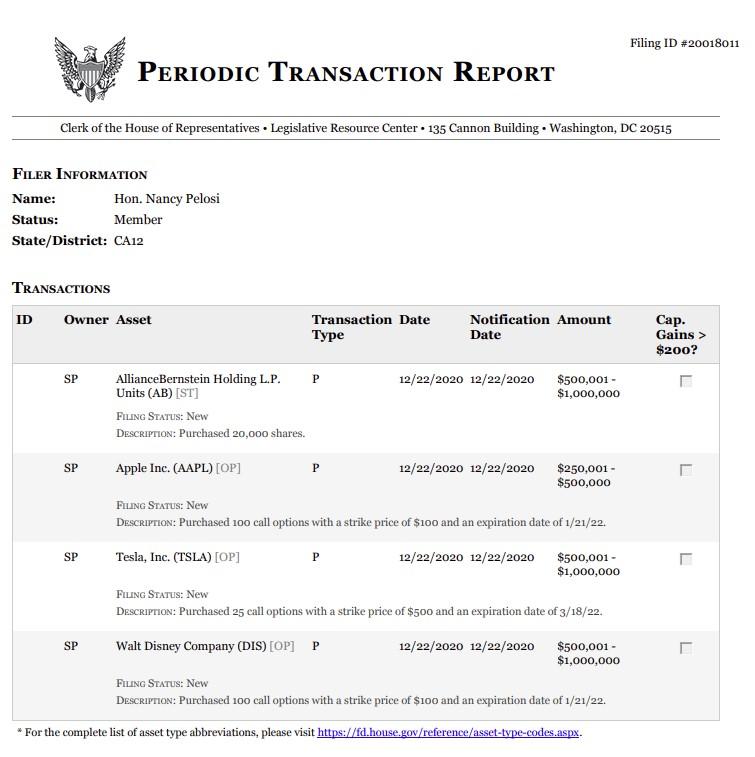
Allow us to offer a partial answer. If you were Nancy Pelosi and her husband, you were buying call options in names like Apple, Tesla and Disney. That's what a new disclosure, detailed in Barron's, revealed late last week. 

Paul Pelosi purchased LEAPS in Tesla, Apple and Disney and shares in AllianceBernstein on December 22, the disclosure revealed. In other words, it's not just clueless retail Robinhood investors that are speculating; it's also clueless politicians. 

He purchased 100 $100 strike Apple calls that expire in January 2022 and paid between $250,000 and $500,000 for them. He also bought 25 in the money Tesla calls, selecting the $500 strike calls with a March 2022 expiration, according to the report. Those cost between $500,000 and $1 million. Finally, he bought between $500,000 and $1 million in Disney options, buying 100 calls at a $100 strike that expire in January 2022. 

He also "paid $500,001 to $1 million for 20,000 shares of global investment firm AllianceBernstein," putting his average price around $33.37.

Obviously, the call option purchases are worth noting - not only because they are leveraged investments and are far more risky than buying outright stock - but because the Speaker now clearly has a vested interest in the success of names like Tesla, whose trajectories as public companies can be altered drastically by government decisions. 

Paul Pelosi and Speaker Pelosi’s office didn’t respond to requests for comment, Barron's said. Can't say we're surprised.

TikTok Mansions Are Publicly Traded Now


Time to learn about reverse takeovers, kids!

The Clubhouse, in Beverly Hills, one of several creator houses operated by West of Hudson Group, which took its holdings public in an unusual deal on Wednesday.
Credit...Clubhouse

A business trying to make money off mansions full of TikTok influencers has gone public on the stock market through an unusual deal. It involves a former Chinese health care company, and if that sounds confusing, well, we can explain.

Social media entrepreneurs have rushed to find ways to make money from stars on popular platforms like TikTok. West of Hudson Group, for one, operates a network of content houses where many prominent young influencers live.

Houses like these function as management companies, taking a percentage of revenue from the creators living in them. The influencers often don’t pay rent, but produce content for brands and promote products as a form of in-kind rent.

Dozens of influencer houses have arrived in the Los Angeles area over the last year, and the companies that run them have been searching for sustainable business models. Going public, though, is a new strategy.

ADVERTISEMENT

Continue reading the main story

West of Hudson was acquired this week by Tongji Healthcare Group, an entity in Las Vegas that was incorporated by a Chinese hospital in 2006 but had no assets at the end of 2019.

  • Dig deeper into the moment.
Subscribe for $1 a week.

The deal was a reverse takeover, in which a private company (in this case, West of Hudson) is acquired by an already-public one (Tongji Healthcare) but ends up in control. The deal closed on Wednesday.

There were more maneuvers behind the scenes. Before the reverse merger, Tongji itself was acquired by the investors who control West of Hudson, a New Jersey real estate operator named Amir Ben-Yohanan and his business partners.

What it all adds up to is that the combined company, which has applied to be renamed Clubhouse Media Group, is now listed on the so-called pink sheets market, where tiny public and often speculative companies trade. On Friday, Tongji’s stock closed at $2.30, 38 percent below its August high.

Extremely low priced stocks — known as penny stocks — are extremely volatile. While sophisticated investors may dismiss such a risky investment, inexperienced investors, many of whom are active on online trading platforms like Robinhood, have an appetite for them, and for companies in the thick of social media trends.

ADVERTISEMENT

Continue reading the main story

Influencer content houses often revolve around drama. Many last only a few months before internal conflict or a dispute between talent and management leads to their disintegration. (In July, The New York Times reported that several content houses, including the ones owned by West of Hudson, were shopping around reality shows, using drama as a selling point. None have been sold.)

DEALBOOK: An examination of the major business and policy headlines and the power brokers who shape them.

Clubhouse, the primary influencer house in West of Hudson’s network, was co-founded in March by Mr. Ben-Yohanan, Christian J. Young and Daisy Keech, a social media influencer. Its first location, in Beverly Hills, has expanded into a network of influencer mansions including Clubhouse Next, Clubhouse for the Boys, Clubhouse Malta and Not a Content House.

The primary Clubhouse location in Beverly Hills has seen a revolving door of talent since it opened. Ms. Keech moved out in March, and others soon followed. Several houses have been shut down. Clubhouse Next closed in September, and Clubhouse for the Boys was discontinued last month. Former residents have complained about problems with management and life in the houses. (Over the summer, members of the Clubhouse and Clubhouse for the Boys were also criticized for hosting parties in defiance of coronavirus guidelines.)

West of Hudson also owns Doiyen, a talent management company, and WOH Brands, a brand incubator that has started clothing lines including Rich Wife and websites where fans can purchase behind-the-scenes content from Clubhouse talent.

ADVERTISEMENT

Continue reading the main story

It may be hard to attract investors in the public markets, however.

In the first six months of the year, West of Hudson had revenue of nearly $96,000 but a loss of $983,000. Mr. Ben-Yohanan, the company’s chief executive who controls 62 percent of the stock, according to a recent securities filing, provided it with a loan of just over $1 million. The company can draw nearly $4 million more from him, according to the filing, which also said Tongji said may need to raise money in the markets to finance operations and grow.

In an interview, Mr. Young said the company was looking at options for raising capital in both the debt and equity markets, but declined to give more details.

According to the Tongji filing, Mr. Ben-Yohanan founded West of Hudson Properties, a New Jersey real estate company that owns or manages over $300 million in multifamily properties. He is listed as the tenant on two of the main Clubhouse properties, according to the filing, which added: “While Mr. Ben-Yohanan intends to assign these leases to the Company in the future, there is a possibility that Mr. Ben-Yohanan may not assign these leases in the near term, or at all.”

A call to West of Hudson Properties seeking comment from Mr. Ben-Yohanan was not returned. In addition to being chief executive, he is listed as Tongji’s principal financial and accounting officer.

Financials aside, companies associated with social media trends are proving attractive among new, young investors. Zach, a 12-year-old investor who has established a following on YouTube and Twitter, is one of many young people who have gotten into stock trading, largely by watching YouTube videos. “There’s a lot more young people in the stock market than people think,” he said.

ADVERTISEMENT

Continue reading the main story

He trades stocks under his parents’ names (they monitor his usage) using a U.K. investing platform called Trading 212. He said that he’d need to look at the company’s financials before determining if it was a sound investment, but could see others his age being interested.

“For most kids who invest in the stock market, there’s interest in new kinds of social media trends and companies like TikTok and wanting to invest in things like that,” Zach said. A company that’s affiliated with high-profile social media stars, he said, is “100 percent something they’d be interested in.”

ImageThe investment app Robinhood is popular with young investors new to the stock market.
Credit...Jim Watson/Agence France-Presse — Getty Images

Trading in penny stocks has surged this year. After the Covid pandemic shuttered sports leagues earlier this year, many frustrated sports bettors moved to the stock markets. The shift coincided with a widespread move — initially pioneered by trading app Robinhood — toward cutting trading fees, which further encouraged speculation in lower priced shares.

Such stocks, however, often have bleak business prospects and weak management teams. And with little professional trading activity or analysis, penny stock prices are volatile and driven by rumor and speculation in online message boards, with little concern for the fundamental likelihood of the business making money.

Through October, some 23 percent of shares traded in American stock markets were priced under $5, according to the New York Stock Exchange. In the same period in 2019, they accounted for around 14 percent of trades.

Taylor Lorenz is a technology reporter in Los Angeles covering internet culture. Before joining The New York Times, she was a technology and culture writer at The Atlantic and The Daily Beast. @taylorlorenz

Peter Eavis is a New York based reporter covering companies and markets. Before coming to the Times in 2012, he worked at The Wall Street Journal.  @uwsgeezer

A version of this article appears in print on Nov. 21, 2020, Section B, Page 4 of the New York edition with the headline: TikTok Houses Taken Public, Hoping to Lure New Investors . Order Reprints | Today’s Paper | Subscribe