Investors shouldn’t stay on the sidelines in the 2020 market, Ray Dalio said on Tuesday, because “cash is trash.”
The billionaire investor thinks “there’s still a lot of money in cash,” saying that “everybody is missing out, so everybody wants to get in.”
Dalio doesn’t think there will be a recession this year and he said investors should look beyond the 2020 U.S. presidential election.
WATCH NOW
VIDEO05:03
Ray Dalio: ‘Cash is trash’ in the 2020 market
Ray Dalio, founder of investment firm Bridgewater Associates, said on Tuesday that he thinks investors shouldn’t miss out on the strength of the current market and they should dump cash for a diversified portfolio.
“Everybody is missing out, so everybody wants to get in,” Dalio said, speaking to CNBC’s “Squawk Box” at the World Economic Forum in Davos, Switerzland.
Dalio advised having a global and well-diversified portfolio in this market and said the thing people can’t “jump into” is cash.
“Cash is trash,” Dalio said. “Get out of cash. There’s still a lot of money in cash.”
Dalio’s firm Bridgewater manages about $160 billion. His declaration that investors should not stay on the sidelines is one he’s made before, as in 2018 he declared that those holding cash were “going to feel pretty stupid” for missing the market’s run up.
“You have to have balance ... and I think you have to have certain amount of gold in your portfolio,” Dalio said, reiterating his call last year that gold will be a top investment in the years to come.
While he endorsed buying a bit of gold, he warned against more speculative investments like bitcoin.
“There’s two purposes of money, a medium of exchange and a store hold of wealth, and bitcoin is not effective in either of those cases now,” Dalio said.
Dalio’s warning for the next five years
Dalio doesn’t think there will be an economic downturn this year and he said investors should look beyond the 2020 U.S. presidential election.
“If you get a downturn – and there’s a good probability in the next [presidential] term you’ll get a downturn – and you don’t have effective monetary policy and you have people at each others throats, I’m worried about that,” Dalio said.
“I would say there’s a 20% chance every year [of a downturn],” Dalio added.
He believes the Federal Reserve is now in a position where it can longer stimulate the U.S. economy like has in the past, notably by lowering interest rates.
“You used to push a button and it would go up,” Dalio said.
But if U.S. interest rates continue to fall, and U.S. federal politics remain highly divisive, Dalio worries that the economy won’t be able to bounce back like it has in the past.
“We’re going to have larger deficits which we’re going to print money for,” Dalio said. “At a point in the future, we still are going to think about what’s a storeholder of wealth. Because when you get negative yielding bonds or something, we are approaching a limit that will be a paradigm shift.”
Gut Feelings’ Are Driving the Markets‘Gut Feelings’ Are Driving the Markets
Valuations are high, but investors are still willing to hold, because of a visceral emotion driven by President Trump.
redit...Mark Pernice
By Robert J. Shiller
The United States stock market is trading at a very high level today. The data show where the market stands, but don’t tell us how it got there. For an explanation of that, we need to take into account a factor that sound very unscientific: “animal spirits,” sometimes called “gut feelings.”
First, let’s look at some of the numbers. More than 30 years ago, the economist John Campbell and I developed what we have called the Cyclically Adjusted Price Earnings (C.A.P.E.) ratio, a measure that enables the comparison of stock market valuations from different eras by averaging the earnings over ten years, thus reducing some of the short-term fluctuations of each market cycle. C.A.P.E. reached 33 in January 2018 and is almost as high now, at 31. That number might seem meaningless in itself, but it is significant when you consider that it has been as high or higher on only two occasions: 1929, just before the 85 percent stock market crash ending in 1932, and in 1999, just before the 50 percent drop at the beginning of the new millennium.
People will point this year to low interest rates to justify the high C.A.P.E. ratio. But interest rate levels historically have not correlated well at all with the C.A.P.E. For example, low long-term rates did not explain the high C.A.P.E. ratios in 1929 and 1999, nor did rising long-term interest rates explain subsequent market crashes.
That brings us to another factor, which John Maynard Keynes called “animal spirits.” It is a sense of optimism and ready energy to be entrepreneurial and take risks, and it has been adjudged to contribute to high stock market levels. Animal spirits are not adequately measured by business consumer confidence indexes, because the surveyors do not probe for such deep feelings.
High animal spirits in the stock market are often associated with the disparagement of traditional authority and expert opinion. This popular narrative often advocates relying on your “gut feelings” to try what experts say is doomed to failure.
President Trump uses this kind of language. Recently, for example, he said “I have a gut, and my gut tells me more sometimes than anybody else’s brain can ever tell me.”
Make America Great Again (MAGA), Mr. Trump’s election slogan, remains on his supporters’ lips. The question for the market outlook hinges partly on how the Trump narrative — the notion that he and his followers are on the road to a triumphant future — will evolve.
Belief in the MAGA narrative would probably encourage people to buy into the stock market, even at elevated levels, thinking it will go up. It is more complicated to anticipate the actions of those who do not believe in Mr. Trump’s supposedly intelligent gut.
While skeptical themselves, they may well believe that enough other people believe, so the markets will thrive, at least in the short term. Investing for the short term — “speculating” is another word for this — tends to be influenced by thoughts that investors have about the thoughts of other investors.
This “gut feeling” narrative is not conterminous with the current bull market in its entirety, but seems to be an important factor permitting the United States economy and markets to move ahead amid widely reported fears of a coming global recession.
Long before the Trump presidency we saw milestones in public awareness of thinking that comes “from the gut.” For example, there is the 2001 best seller by Jack Welch, “Jack: Straight From the Gut,” (written with John A. Byrne) about his successes as chief executive of General Electric from 1981 to 2001. Mr. Welch described his management style as intuitive, and not relying on experts, whose analyses he viewed as often phony. Mr. Welch says, for example: “I crossed out the payback analysis on his last chart. I drew an “X” over the transparency and scrawled the word Infinite to make the point that the returns on our investment would last forever. I meant it.” Whether Mr. Welch’s supposed genius has been called into question by the sharp drop in share value of G.E. after he left the company is a matter of debate.
The 1997 book “Rich Dad Poor Dad,written by Robert Kiyosaki, with Sharon Lechter, described two fathers(one his own, the other a friend’s). The book’s publisher, Plata Publishing, reported that the book sold nearly 40 million copies as of 2017. His own, poor dad had college degrees, deferred to authority and told his son that many things were impossible. The uneducated but rich dad told him he should think about how he can make his dreams a reality. Donald Trump comes across to many many people rather like the rich dad. (Kiyosaki and Trump have co-authored two books, in 2006 and 2011.)
Then there is the 2011 book “Steve Jobs,” by Walter Isaacson, which described the co-founder of Apple this way: “Jobs was more intuitive and romantic and had a greater instinct for making technology usable, design delightful, and interfaces friendly.”
We are being saturated with these kinds of narratives today: describing inspired young people, some of whom drop out of college, who surpass overly polite conformists pursuing dull, bureaucratic work lives. For people who buy into this dream, one simple step is to avoid the mistake of missing out, by acting like a rich person and buying stocks.
This is obviously not an explanation for the level of the entire market, but it is surely part of it.
WASHINGTON (Reuters) - Federal Reserve Chairman Ben Bernanke told lawmakers on Thursday the U.S. economy did not appear headed for recession, but warned growth could prove weaker than expected and inflation higher.
Wind and solar power can produce seven times more useful energy for cars, dollar for dollar, than gasoline with oil prices near current levels, according to BNP Paribas SA.
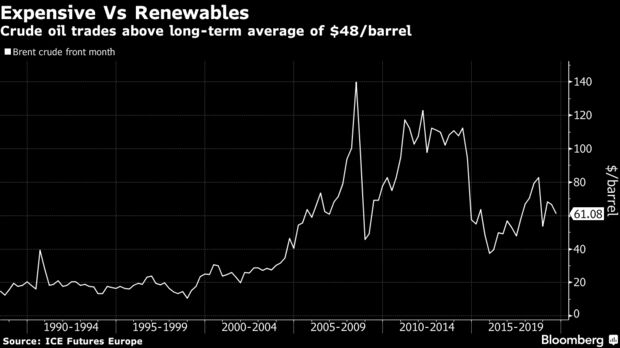
Oil will have fall to $9-$10 a barrel in the long-term in order for gasoline cars to remain competitive with clean-powered electric vehicles, and to $17-$19 a barrel for diesel, Mark Lewis, global head of sustainability research at BNP’s asset management unit, said in a research report. U.S. benchmark crude was trading at about $55 in New York on Monday.
“Our analysis leads to a very stark conclusion for the oil industry: for the same capital outlay today, wind and solar energy will already produce much more useful energy for EVs than will oil purchased on the spot market,” Lewis said. “These are stunning numbers, and they suggest that the economics of renewables in tandem with EVs are set to become irresistible over the next decade.”
Stark Numbers
Energy return on capital invested
Note: Energy return from new renewables projects in tandem with EVs, versus oil used for gasoline vehicles for a $100b outlay -- in TWh
Lewis coined the term “energy return on capital invested” to explain the economics of road transport. It’s a measure of the money spent on oil and renewables and the differential in their net energy produced when used to provide mobility, he said.
Still, changes will take time.
“The oil industry today enjoys a massive scale advantage over wind and solar of several orders of magnitude – oil supplied 33% of global energy in 2018 compared with only 3% from wind and solar,” Lewis said.
Higher carbon prices applied in more places around the world would improve the chance of meeting the emission targets implied in the Paris climate deal struck in 2015, Lewis said.
Germany is among nations considering including carbon pricing in its transport sector, something California already does.
(Updates with comment on carbon in penultimate paragraph.)
Value investors are known for being a hardy bunch, willing to buy into beaten-down stocks that everyone else thinks are a disaster. But cheap stocks have underperformed horribly over the past 12 years, and even some fund managers who specialize in buying them wonder in private if the technique no longer works. Could value be dead?
I’m a natural value guy, and not just in stocks. I like bargains, and will trek across town—or to today’s equivalent, the third page of the search engine—to find them. Over the long run of history, bargain hunting in stocks has won out, by a lot. So before paying up to buy expensive stocks on the grounds they will get even more expensive, I want to know why this time is different.
The dire years have produced plenty of theories for why value hasn’t worked of late. Perhaps markets are more efficient than they used to be, as algorithms take the emotion out of investing. Perhaps the rise of capital-light companies means traditional value metrics such as price-to-book don’t work any more. Or perhaps superlow interest rates favor fast-growing companies, and so punish struggling value stocks, which tend not to have a convincing story to tell about the future. Value investors often argue that the poor performance is just one of those things that has to happen from time to time, because if it was easy, everyone would do it.
SHARE YOUR THOUGHTS
How much longer do you think stocks will fall on good economic news? Join the conversation below.
The investors who picked the expensive growth companies in the past decade got it right. They frequently claim that this time it really is different. The new technologies that traded at high multiples of book value, of earnings, and of sales, showed themselves worthy. Companies such as AppleInc.,MicrosoftCorp. , AlphabetInc. and FacebookInc. have grown to become the biggest stocks in the world by making a ton of money.
One firm that uses value among several approaches to investment thinks we’ve seen this before—the last time a major disruptive technology caught on.
The 1920s and 1930s for investors bring to mind the 1929 stock-market crash. Chris Meredith at Stamford, Conn.-based O’Shaughnessy Asset Management points out it was also the period when the automobile shifted from early takeup to widespread deployment, bringing mass production and distribution of consumer goods.
General Motors and the Standard Oil companies were the leading stock-market disrupters of the time, trading at valuation premiums to “old” industries such as steam-driven railroads, utilities and shipbuilding. Their disruption looks very like today’s: the period from 1926 to the late U.S. entry into World War II in 1941 was the last time value underperformed for as long as it has since its June 2007 high. Data from Prof. Kenneth French at Dartmouth’s Tuck School of Business shows value stocks have lagged behind on average 5 percentage points a year behind growth stocks since then, just worse than the same period up to the summer of 1939.
Mr. Meredith uses the framework developed by academic Carlota Perez, which shows how previous technological revolutions followed similar patterns of boom and bust, then a multiyear intermediate phase when the winners are established, before maturity. The internet age only really reached this intermediate phase with the development of the iPhone, launched in 2007 just as the financial crisis was starting.
From 1926 to the war, the cheap value portfolio is crammed with utilities, the stocks that had led the electrification revolution but had become mature and dull. The go-go growth stocks were in manufacturing, with few of them cheap enough for value buyers to pick.
There’s a similar industry bias today: value has heavy exposure to banks and other financial stocks, which helped it outperform before the crisis but dragged it down since. This time, the go-go growth stocks are mostly in the technology sector (although Amazon is a retailer), where value has little exposure.
Value investors clutching at straws might hope that the online takeover is virtually complete, with the internet giants moving into the “synergy” phase where the new technologies boost the economy, while the excitement they once generated wears off. Meanwhile, old industries might start to benefit by adopting parts of the new technologies, just as beaten-up coal railroads became stock-market winners when they shifted to diesel trains.
I find the historical comparison compelling. But it isn’t so obvious that we’re at the end of the internet disruption yet. The big shift that allowed value to start performing again after World War II was that the disruption was done, and the old industries had vanished or adjusted to cope.
It’s true that music retailers have gone the way of horse-drawn transport, and the bookshops that are left have shaken up their business models. There are also signs of the tech giants competing with each other, not just gobbling up old industries, such as Amazon’s entry into advertising. Many old-tech business models have changed, too, to fit better in a world of online competition; meanwhile governments are under pressure to rein in or tax the big tech winners. Against that, the big tech companies are investing heavily in technologies that could disrupt yet more industries.
What keeps me clinging on to the value creed is that all of this is priced in, and then some. Back in 2007 value stocks had had a great run, and were less of a bargain compared with growth stocks than any time since the mid-1980s, according to Vitali Kalesnik, director of research for Europe at Research Affiliates. They are now much cheaper than usual compared with growth stocks (although the gap was bigger still in the dot-com bubble), so there’s a better chance that the bad news is already recognized.