The jump in inflation that the Covid crisis has brought on might not be as transitory as many have hoped. But for the economy to smoothly adjust to a post-pandemic future, higher prices could be necessary.
Covid-related shortages have driven prices for all kinds of things sharply higher, something more than evident in last Wednesday’s inflation report from the Labor Department, much less a trip to the store. The global semiconductor shortage has slowed production of cars, for example, and new vehicle prices last month were up 8.7% from a year earlier, the inflation report showed. Supply-chain snarls have helped push prices for furniture 11.2% higher.
The consensus is that many of these shortages will ease over the next several months. Semiconductor supplies will ramp back up. An increase in vaccinations globally will help bring Covid under control, reducing pandemic-related shipping and production snarls, like those that recently hit Vietnam. In his press conference following last month’s Federal Reserve meeting, Fed Chairman Jerome Powell said that while the effects of supply bottlenecks “are prominent for now, they will abate.”
Yet what is happening with prices isn’t just about supply, but demand, too. The pandemic has brought about changes in what we want to spend our money on and where we want to live and work that could prove persistent. Appliance prices aren’t up just because of supply snarls, for example, but because the Covid crisis increased the appeal of suburban living. So even if supply chains get fixed, demand could still be hard to meet, with prices continuing to rise as a result.
NEWSLETTER SIGN-UP
Heard on the Street
Agenda-setting analysis and commentary on the biggest corporate and market stories.
SUBSCRIBE
WSJ NEWSLETTER
Notes on the News
The news of the week in context, with Tyler Blint-Welsh.
One of the clearest economic changes the pandemic brought on was a massive increase in demand for goods, versus services. At first, this seemed entirely temporary: People were buying more stuff like videogame consoles and groceries because they were hunkered down at home. But even though the vaccine rollout and the easing of Covid restrictions has increased demand for services such as restaurant meals, demand for goods has shown staying power. In the second quarter of this year, consumer spending on goods was 18% higher than in the fourth quarter of 2019, after adjusting for inflation. Consumer spending on services was 3.4% lower.
That change in preferences is helping drive a divergence in inflation as well. Wednesday’s inflation report showed prices for consumer goods were up 9.1% from a year earlier, while services prices were up 3.2%.
There is obviously scope for services to gain back ground if Covid loosens its grip. Even so, the share of spending devoted to goods may stay larger than before. If more people keep working from home some of the time, for example, they will spend less money at lunch joints near their offices, and more on groceries.
Similarly, if businesses continue to hold many client meetings virtually, they will spend less on travel, and more on tech equipment. Personal-computer makers are betting that a higher number of workers will need more than one computer as a result of remote-work arrangements, translating into higher PC demand post-pandemic.
Related Video
How Retail Cheese Prices Weather Market Volatility
YOU MAY ALSO LIKE
UP NEXT
0:00 / 6:09
3:08
How Retail Cheese Prices Weather Market Volatility
With food markets on a wild ride lately, cheese has seen more volatility than most. Yet in supermarkets, prices have remained relatively stable. Here’s why sharp changes in wholesale cheese prices are slow to make it to consumers. Illustration: Jacob Reynolds
Geographic shifts in demand matter, too. More people moving to the suburbs or smaller cities, and people who live in the suburbs working from home more often, could equate to more demand that suburban and smaller-city businesses need to meet. There does appear to be a divergence in what is happening with prices depending on population size: Overall consumer prices in areas with over 2.5 million people were up 4.8% from a year earlier in September, while prices in areas with 2.5 million or fewer people were up 5.9%.
Demand-driven price increases carry an important message to businesses that are benefiting from them: You can make even more money if you can supply more. That entails buying new equipment, opening new locations and, most important, hiring additional workers. Meanwhile, businesses that experience weaker demand often can’t lower prices, in part because cutting worker wages isn’t feasible.
SHARE YOUR THOUGHTS
How has your spending changed over the past 18 months? Join the conversation below.
In work she presented at the Fed’s annual conference in Jackson Hole, Wyo., in August, economist Veronica Guerrieri and her co-authors argue that inflation can help facilitate the economy’s response to shifts like the current one because it encourages expansion where demand is rising. It also helps draw workers away from moribund businesses where wages aren’t rising because inflation is cutting into how much those workers’ paychecks can buy.
For Fed policy makers, it could amount to a dilemma. On the one hand, they don’t want too-high inflation to become ingrained in the economy, and that counts as an argument for raising rates next year if inflation doesn’t cool down. But on the other hand, if inflation is helping lubricate the economy to make necessary adjustments, maybe they should accept a bit more of it than they otherwise might.
Corrections & Amplifications In the second quarter of this year, consumer spending on goods was 18% higher than in the fourth quarter of 2019, after adjusting for inflation. An earlier version of this article incorrectly said it was 18% higher than in the fourth quarter of last year. (Corrected on Oct. 15)https://www.wsj.com/articles/at-times-like-these-inflation-isnt-all-bad-11634290202
Solar Energy (Photovoltaics, or PV for short) will be the dominate form of energy on Earth in the next couple of decades. Governments don’t need to subsidize PV, and Al and Greta don’t need to shame us with False Narratives:
Rather, the real Story is that there is no stopping PV. Here’s some Data for your consideration:
For about the last 5 years, longer neglecting Wind Power, PV has been the leading form of newly-installed electrical power generation worldwide (i.e., more PV installed than either Coal, Natural Gas, Wind, Hydro, Nuclear, Oil, etc.); and
PV production and installation has been doubling about every 2 years for about the last 30 years, and this trend continues; and
One Nuclear Power Plant Equivalent, NPPE, of PV is installed about every two weeks. If this trend continues, which I expect, within the next decade the world will be installing about 1 NPPE of PV per day. At what rate are we installing Nuclear Power Plants1 to “combat the ‘Climate Crisis’”2?
Back when I used to give talks on Solar Energy, Stan Ovshinsky told me to take out all of the IPCC CO2 Anthropogenic Global Warming crap from my talks (I thought this would help promote Solar, true or not). His reasoning: PV will win not because it is “Good” or “Green” or because of social pressure or government mandates; rather we (PV) will win because PV will be the lowest-cost endless-source of energy on the planet, Plain and Simple (“We shall beat them at their own game”, he said). And Stan was right, and that day has arrived. And there are certainly no resource limitations: after Oxygen, Silicon is next most abundant element in the Earth’s crust.
What made this happen ? It wasn’t any “new technology”; it was rather something quite simple: mass production. A few decades ago the U.S. produced over 90% of the World’s PV; now we are in the single digits and falling fast while the Chinese are producing about 60% of the World’s PV and close to 90% of the World’s Solar Thermal panels. Of course expect to continue learning in the “News” about the West preaching to the Chinese about the “Climate Crisis” (as well as Human Rights, Democracy, Freedom of Speech, etc.).
Did the “Chinese steal our technology”? Well, Yes and No. Back in the 80’s you could buy BP (British Petroleum) PV panels. These aluminum-framed modules used silicon wafers sandwiched between glass and encapsulated with EVA. Here in the West, with the help of Industry Leaders, the Department of Energy, and National Renewable Energy Laboratory (NREL), we “proved” that this technology was too expensive and that new thin film technology was necessary to make PV cost-effective; more research was always needed before we could deploy. On the Other-Other hand, the Chinese “proved” that this almost half-century-old silicon-wafer-technology, encapsulated with EVA between glass with aluminum frames, and of course continuous improvements, is indeed cost-effective if mass produced. Pretty simple, huh? Instead of trying to prove that you can’t do it, spend your effort proving that you can do it ! I should do that; but on the other-other hand, while it might be better to light one candle than to curse the Darkness, it sure is more fun to curse the Darkness !
We don’t need the CO2 (harmless plant food) “Climate Crisis” False Narrative to promote PV; rather, PV is here today and there is no stopping it. Plain and Simple. Think of PV as a HUGE Steam Roller coming your way and do you really want to get in the way of it ?
Of course you can expect to see the U.S. continuing to wage war over oil. Like seriously, as cool as PV is3, you can’t power an aircraft carrier or super-sonic F35 with PV ! Oil is still very important to lubricate the war machine …
Climate Crisis, formerly Climate Change, formerly Global Warming, formerly Anthropogenic Global Warming. As a very intelligent friend said to me, “Is it even linguistically possible to be against a Climate Crisis ?”
I live very comfortably off-grid with PV [Chinese ductless DC inverter heat pumps ON in cooling mode and with the doors open so that I don’t “waste energy”] half the year here in Southern Indiana.
“Higher gasoline costs, if left unchecked, risk harming the ongoing global recovery. The price of crude oil has been higher than it was at the end of 2019, before the onset of the pandemic. While OPEC+ recently agreed to production increases, these increases will not fully offset previous production cuts that OPEC+ imposed during the pandemic until well into 2022. At a critical moment in the global recovery, this is simply not enough. President Biden has made clear that he wants Americans to have access to affordable and reliable energy, including at the pump.” – Jake Sullivan, National Security Advisor (emphasis added)
Almost a decade ago, the official mascots of the London 2012 Summer Olympics were revealed. It didn’t go very well. Meet Wenlock and Mandeville:
At the time, I was perusing a magazine article collecting various reactions to the mascots – I think it was in Time but I can’t be sure – and one commentator delivered a line that will stick with me forever.
“This can only be the work of a committee. It has cc written all over it.”
I am reminded of Wenlock and Mandeville as I observe America’s rambling approach to energy policy over the past several years. When you ponder the logical consequences of where we are headed, it is hard not to conclude that this too must be the work of a committee, and a disjointed one at that. More on the members of that committee a little later.
Let’s start with the opening quote for this piece, which I took from an official White House statement, because it is quite the stunner. The President and his allies are limiting domestically produced oil and gas at every opportunity, which should come as no surprise – they ran for office on exactly this policy, after all. The controversial Keystone Pipeline project was permanently cancelled shortly after Biden took office, signaling a major policy shift from the Trump administration. In late January, Biden issued a broad moratorium on oil and gas leases on federal lands and waters (subsequently partially reversed). Just last week, an Obama-appointed federal judge in Alaska reversed a previously approved $6B development project in her state, much to the chagrin of ConocoPhillips, the project’s owner.
If you think the burning of fossil fuels is bad for the planet and should be slowed and eventually stopped altogether, these actions are perfectly fine – even laudable. What is not fine is to expect that the price of oil (and by extension, gasoline) wouldn’t go up as a result of these policies. It takes a special kind of stupid to think that crimping supply for a highly inelastic commodity wouldn’t spike prices higher, especially as the economy continues to experience an accelerated recovery from the impact of Covid-19. Further, this is the exact result you should want if your intent is to reduce demand for fossil fuels. You don’t have to have a PhD in economics to understand that destroying demand with price is particularly effective. Higher prices for fossil fuels also make the development of alternatives more economically feasible, thereby accelerating our environmental transformation. There’s simply no path to substantially reduced carbon intensity without substantially higher prices for fossil fuels.
Crazy, I know.
And that is what makes Sullivan’s statement so confounding. By begging OPEC+ to produce more, thereby keeping US gasoline prices under control, the President is effectively stoking demand for fossil fuels while ceding market share – and power over our economic future – to countries that generally don’t like us very much, have minimal to no environmental or labor safeguards, and operate in volatile parts of the globe (necessitating massive US military expenditures to safeguard critical shipping lanes). It is truly a worst-of-all-worlds situation.
The President also is making a major push toward electrifying the US passenger vehicle market. He recently held a summit at the White House with key executives from the automotive industry (with one notable exception – Elon Musk was strangely absent from the invitation list). I happen to think full battery electric vehicles (BEVs) are a suboptimal environmental solution given the current state of battery technology, especially when compared to plug-in hybrid options (PHEVs), but I’m generally pro-electrification (with the notable exception of fences around chicken coops).
My beef with the President’s agenda is simpler. Where will the industrial metals and electricity needed for this conversion to electric come from? While the President proclaims that he will prioritize the domestic production of strategic minerals, the reality is his administration is making it even harder to get new mines operational. A recent analysis by Thompson Reuters had this to say:
“…the overwhelming effect of many changes proposed by the new administration will be to discourage, through extensive regulation, all forms of domestic mineral development and extraction. The new and revised regulatory framework will have the effect of:
· Prohibiting new mines outright in many places.
· Increasing the costs of development or operation of existing mines.
· Lengthening the time needed to bring a mine into production.”
Our nation’s electricity grid is woefully unprepared to even support normal economic growth going forward. It simply can’t support the revolution in transportation that the President proposes. Because of lack of investment, poor maintenance, and political opposition to the development of new power plants using traditional fuels, we are near a critical breaking point. Look no further than the rolling blackouts in California and the struggle Texas is having keeping its lights on. A thoughtful essay by Marsh McLennan opened as follows:
“To say that the United States has an aging electric transmission infrastructure is a sizable understatement. The average age of the installed base is forty years old, with more than a quarter of the grid fifty years old or older. While the system’s sheer longevity is a testament to the engineering expertise of our forebears, that aging infrastructure is long overdue for a major overhaul.”
The end result of these policies will be similar to what we will see with oil. As BEVs and (hopefully) PHEVs gain market share, the US will become increasingly reliant on dirty metals derived from international mines with minimal environmental and labor standards. Prices for these metals will soar, impacting all supply chains that rely on them today. We will enrich our international geopolitical opponents at the expense of the average US consumer. Our electric grid will become more unreliable. Rolling blackouts will become more common, and spread beyond California and Texas. It isn’t a pretty picture.
What would President Doomberg do differently? In the unlikely event that the 47th President of the United States is a paranoid chicken, the energy policy motto would be simple: Better is Better.
Under President Doomberg, the US would pass an infrastructure bill that actually invests in infrastructure. The bill would only fund a revitalization of our nation’s electric grid. There would be a zero-pork policy. Imagine that? I would sell the bill as a real investment in our children’s future. That’s money worth printing. Better is better.
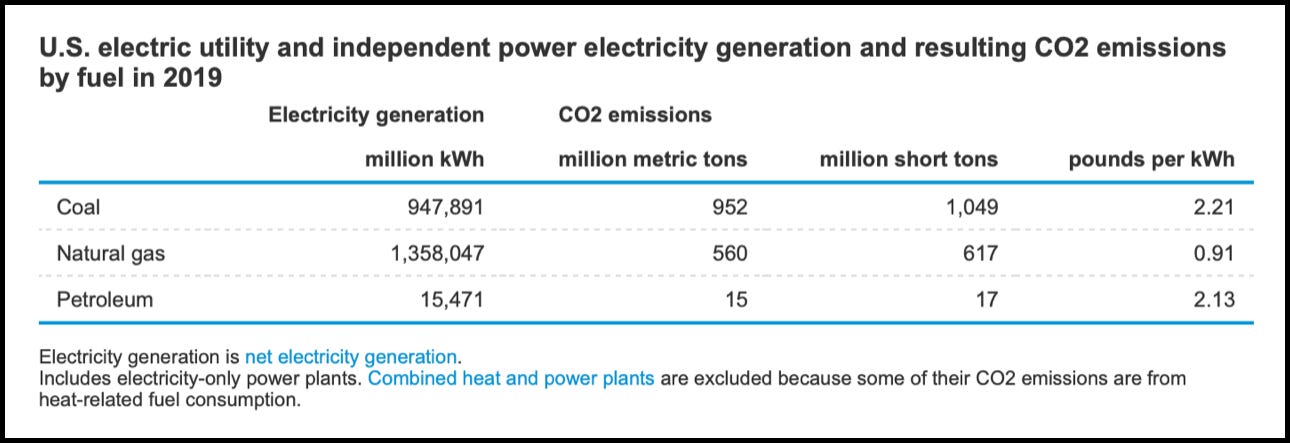
Under President Doomberg, the US would replace coal-fired power plants with plants that burn natural gas. Electricity derived from natural gas is 60% less carbon intense than electricity derived from coal. Additionally, the burning of coal emits all manner of other toxins into the environment, while natural gas burns so cleanly we allow it to be piped into our homes for cooking and heating. These new natural gas plants would form the base load for future electricity generation. Better is better.
Under President Doomberg, the US would advance its development of renewable electricity, especially wind and solar, but would supplement these investments with a national initiative – something on the scale of the Manhattan Project – to create affordable, grid-scale batteries from readily available materials. Current lithium ion battery technology isn’t ideal for grid storage for a variety of reasons, and we’ll need those batteries elsewhere (see below). The development of such batteries is critical for the integration of renewables, would help with grid balancing, and would reduce the need for peaking power plants. Better is better.
Under President Doomberg, the US would prioritize the development of PHEVs to replace traditional internal combustion engine vehicles. On a gallon-of-gasoline-abated-per-pound-of-battery basis, PHEVs are far superior to full BEVs. I would institute a $10,000 federal tax credit for any vehicle that has at least 50 miles of electric range before the backup internal combustion engine kicks in. The technology for these vehicles exists today – no new inventions are needed. This would cut demand for fossil fuels significantly, while minimizing the need to source dirty metals from our geopolitical foes. While I would work to fast-track the approval of new mines for strategic minerals, this approach would lessen the need to do so. It would also eliminate the need for a national electric vehicle charging network, as consumers could rely on traditional gasoline for long trips. Better is better.
Under President Doomberg, the US would revitalize its nuclear power industry. If you claim to be serious about reducing our carbon intensity but you are opposed to nuclear power, you aren’t actually serious about reducing our carbon intensity – you are a scientifically ignorant poseur. That might sound a little harsh, and might even cost me a few subscribers, but it must be said. I’d be intellectually dishonest if I softened the message. Nuclear power is safe, affordable, and must be a critical part of our energy future. In the past 25 years, the US has commissioned precisely one new nuclear power facility, a true failure of political leadership. Opposition to nuclear power is destroying the planet. Get over it. It’s time. Better is better.
Unfortunately, there will never be a President Doomberg, nor do I expect any of these proposed policies to be implemented. President Biden’s de facto committee on energy is fatally conflicted, damning the US to the provably insane policies that are being imposed upon us today. On one end of that committee’s table sits progressive politicians – most of whom have never worked in heavy industry – who are demanding an all-or-nothing approach to energy policy that is completely at odds with sound scientific and economic theory. These politicians are underwritten and enabled by rent-seeking financiers on Wall Street, most notably Larry Fink, chair and CEO of Blackrock – and other similar cocktail-party dwellers – who don’t have to suffer the consequences of the policy recommendations they support. On the other end of the committee’s table sits the President’s base: blue-collar union members who drive pickup trucks for a living, middle-class families struggling to make ends meet, and all manner of economically-disadvantaged citizens. The President knows intuitively that placating the former will harm the latter, which is how we ended up with the policies we have.
If you insist on all or nothing, it will be all for nothing. The planet will be no better off, and we’ll all be poorer.