Tuesday, January 26, 2021

TikTok Mansions Are Publicly Traded Now


Time to learn about reverse takeovers, kids!

The Clubhouse, in Beverly Hills, one of several creator houses operated by West of Hudson Group, which took its holdings public in an unusual deal on Wednesday.
Credit...Clubhouse

A business trying to make money off mansions full of TikTok influencers has gone public on the stock market through an unusual deal. It involves a former Chinese health care company, and if that sounds confusing, well, we can explain.

Social media entrepreneurs have rushed to find ways to make money from stars on popular platforms like TikTok. West of Hudson Group, for one, operates a network of content houses where many prominent young influencers live.

Houses like these function as management companies, taking a percentage of revenue from the creators living in them. The influencers often don’t pay rent, but produce content for brands and promote products as a form of in-kind rent.

Dozens of influencer houses have arrived in the Los Angeles area over the last year, and the companies that run them have been searching for sustainable business models. Going public, though, is a new strategy.

ADVERTISEMENT

Continue reading the main story

West of Hudson was acquired this week by Tongji Healthcare Group, an entity in Las Vegas that was incorporated by a Chinese hospital in 2006 but had no assets at the end of 2019.

  • Dig deeper into the moment.
Subscribe for $1 a week.

The deal was a reverse takeover, in which a private company (in this case, West of Hudson) is acquired by an already-public one (Tongji Healthcare) but ends up in control. The deal closed on Wednesday.

There were more maneuvers behind the scenes. Before the reverse merger, Tongji itself was acquired by the investors who control West of Hudson, a New Jersey real estate operator named Amir Ben-Yohanan and his business partners.

What it all adds up to is that the combined company, which has applied to be renamed Clubhouse Media Group, is now listed on the so-called pink sheets market, where tiny public and often speculative companies trade. On Friday, Tongji’s stock closed at $2.30, 38 percent below its August high.

Extremely low priced stocks — known as penny stocks — are extremely volatile. While sophisticated investors may dismiss such a risky investment, inexperienced investors, many of whom are active on online trading platforms like Robinhood, have an appetite for them, and for companies in the thick of social media trends.

ADVERTISEMENT

Continue reading the main story

Influencer content houses often revolve around drama. Many last only a few months before internal conflict or a dispute between talent and management leads to their disintegration. (In July, The New York Times reported that several content houses, including the ones owned by West of Hudson, were shopping around reality shows, using drama as a selling point. None have been sold.)

DEALBOOK: An examination of the major business and policy headlines and the power brokers who shape them.

Clubhouse, the primary influencer house in West of Hudson’s network, was co-founded in March by Mr. Ben-Yohanan, Christian J. Young and Daisy Keech, a social media influencer. Its first location, in Beverly Hills, has expanded into a network of influencer mansions including Clubhouse Next, Clubhouse for the Boys, Clubhouse Malta and Not a Content House.

The primary Clubhouse location in Beverly Hills has seen a revolving door of talent since it opened. Ms. Keech moved out in March, and others soon followed. Several houses have been shut down. Clubhouse Next closed in September, and Clubhouse for the Boys was discontinued last month. Former residents have complained about problems with management and life in the houses. (Over the summer, members of the Clubhouse and Clubhouse for the Boys were also criticized for hosting parties in defiance of coronavirus guidelines.)

West of Hudson also owns Doiyen, a talent management company, and WOH Brands, a brand incubator that has started clothing lines including Rich Wife and websites where fans can purchase behind-the-scenes content from Clubhouse talent.

ADVERTISEMENT

Continue reading the main story

It may be hard to attract investors in the public markets, however.

In the first six months of the year, West of Hudson had revenue of nearly $96,000 but a loss of $983,000. Mr. Ben-Yohanan, the company’s chief executive who controls 62 percent of the stock, according to a recent securities filing, provided it with a loan of just over $1 million. The company can draw nearly $4 million more from him, according to the filing, which also said Tongji said may need to raise money in the markets to finance operations and grow.

In an interview, Mr. Young said the company was looking at options for raising capital in both the debt and equity markets, but declined to give more details.

According to the Tongji filing, Mr. Ben-Yohanan founded West of Hudson Properties, a New Jersey real estate company that owns or manages over $300 million in multifamily properties. He is listed as the tenant on two of the main Clubhouse properties, according to the filing, which added: “While Mr. Ben-Yohanan intends to assign these leases to the Company in the future, there is a possibility that Mr. Ben-Yohanan may not assign these leases in the near term, or at all.”

A call to West of Hudson Properties seeking comment from Mr. Ben-Yohanan was not returned. In addition to being chief executive, he is listed as Tongji’s principal financial and accounting officer.

Financials aside, companies associated with social media trends are proving attractive among new, young investors. Zach, a 12-year-old investor who has established a following on YouTube and Twitter, is one of many young people who have gotten into stock trading, largely by watching YouTube videos. “There’s a lot more young people in the stock market than people think,” he said.

ADVERTISEMENT

Continue reading the main story

He trades stocks under his parents’ names (they monitor his usage) using a U.K. investing platform called Trading 212. He said that he’d need to look at the company’s financials before determining if it was a sound investment, but could see others his age being interested.

“For most kids who invest in the stock market, there’s interest in new kinds of social media trends and companies like TikTok and wanting to invest in things like that,” Zach said. A company that’s affiliated with high-profile social media stars, he said, is “100 percent something they’d be interested in.”

ImageThe investment app Robinhood is popular with young investors new to the stock market.
Credit...Jim Watson/Agence France-Presse — Getty Images

Trading in penny stocks has surged this year. After the Covid pandemic shuttered sports leagues earlier this year, many frustrated sports bettors moved to the stock markets. The shift coincided with a widespread move — initially pioneered by trading app Robinhood — toward cutting trading fees, which further encouraged speculation in lower priced shares.

Such stocks, however, often have bleak business prospects and weak management teams. And with little professional trading activity or analysis, penny stock prices are volatile and driven by rumor and speculation in online message boards, with little concern for the fundamental likelihood of the business making money.

Through October, some 23 percent of shares traded in American stock markets were priced under $5, according to the New York Stock Exchange. In the same period in 2019, they accounted for around 14 percent of trades.

Taylor Lorenz is a technology reporter in Los Angeles covering internet culture. Before joining The New York Times, she was a technology and culture writer at The Atlantic and The Daily Beast. @taylorlorenz

Peter Eavis is a New York based reporter covering companies and markets. Before coming to the Times in 2012, he worked at The Wall Street Journal.  @uwsgeezer

A version of this article appears in print on Nov. 21, 2020, Section B, Page 4 of the New York edition with the headline: TikTok Houses Taken Public, Hoping to Lure New Investors . Order Reprints | Today’s Paper | Subscribe

Chinese stocks fall as central bank adviser warns of asset bubble


https://www.ft.com/content/357ef660-8827-4776-81ea-9e4abffda811

Chinese stocks fall as central bank adviser warns of asset bubble PBoC moves to tighten liquidity following country’s strong economic recovery from Covid-19 Investors have been closely scrutinising the PBoC’s policy approach against the backdrop of a rapid but incomplete economic recovery from the coronavirus and rising asset prices © Reuters Share on Twitter (opens new window) Share on Facebook (opens new window) Share on LinkedIn (opens new window) Save Thomas Hale and Hudson Lockett in Hong Kong 6 HOURS AGO 6 Print this page Stocks across China dropped after the central bank tightened financial conditions and an official raised concerns that loose liquidity could inflate an asset bubble. The People’s Bank of China early on Tuesday withdrew Rmb78bn ($12bn) of net liquidity through its open market operations, a process through which the central bank and banking system lend to one another. The overnight repo rate, an interbank benchmark, jumped to more than 2.8 per cent — its highest level since late 2019 — from 2.5 percent the previous day. In Hong Kong, the Hang Seng index — which has been boosted this month by record-breaking daily volumes of buying by mainland investors — fell by more than 2.4 per cent. Mainland China’s CSI 300 index of Shanghai- and Shenzhen-listed stocks dropped 2 per cent.

 Investors have been closely scrutinizing the PBoC’s policy approach against the backdrop of a rapid economic recovery from the coronavirus and rising asset prices. The CSI 300 this month hit its highest level since the global financial crisis. The mood is still totally remaining intact in terms of its positivity Andy Maynard, China Renaissance That has put the PBoC under pressure to tighten financial conditions after loosening them in mid-2020 due to the impact of Covid-19, but it is grappling with low or negative levels of inflation despite economic growth exceeding its pre-coronavirus level. Local media reports on Tuesday cited comments from Ma Jun, an adviser to the People’s Bank of China, telling a wealth management forum that the risk of asset bubbles would increase if the central bank did not adjust its policy. “Whether this situation will intensify in the future depends on whether monetary policy is appropriately changed this year,” he said. He added that if not, such problems would “certainly continue” and lead to “greater economic and financial risks in the medium- and long-term”. In late 2020, PBoC restrictions on short-term liquidity led to a spike in interbank borrowing costs. The three-month Shanghai interbank benchmark more than doubled between May and November to more than 3 per cent — its highest level in two years — before it gradually declined. Chinese regulators have already moved to constrain rising property prices. They limited the amount banks can lend to the sector at the end of last year and are targeting leverage among the country’s vast developers. Individual cities have also introduced measures to curb prices. Recommended Markets Runaway Markets Nearly $34bn has flowed from the mainland into Hong Kong’s stock market so far in 2021, according to Bloomberg data. Technology stocks such as Tencent and Meituan have rocketed, with the former adding 28 per cent since New Year. “The mood is still totally remaining intact in terms of its positivity,” said Andy Maynard, managing director at China Renaissance Securities. “Although we have a blip today . . . yesterday was kind of euphoric, last week was kind of euphoric.” But, he added, rising borrowing costs were unlikely to undermine positive momentum in China and other emerging markets. “Where else in the world do you go? Where do you put that money?” he said. “For the global asset allocators who stay in equity, I don’t think you necessarily rush back to the dollar and you definitely are not touching Europe”. Additional reporting by Wang Xueqiao in Shanghai  

China Asset-Bubble Warning Threatens Stock Frenzy in Hong Kong

https://www.bloomberg.com/news/articles/2021-01-26/china-asset-bubble-warning-threatens-stock-frenzy-in-hong-kong 


A chill swept through Chinese financial markets after the central bank withdrew cash from the banking system and an official warned about asset bubbles.

The People’s Bank of China drained about $12 billion via open-market operations on Tuesday. The decision was unusual in the weeks before the Lunar New Year holiday, which in 2021 falls in mid-February, because residents typically need more cash to pay for seasonal travel and gifts. It also went against recent reports in Chinese newspapers that liquidity wouldn’t be tightened before the holidays.

While Tuesday’s withdrawal was small in isolation, it added to signs that Beijing is growing wary of how cheap and plentiful liquidity has stoked excess in markets. PBOC adviser Ma Jun told local media that risks of asset bubbles -- such as in the stock or property market -- will remain if China doesn’t shift its focus toward job growth and inflation management instead.

Read: Pandemic-Era Central Banking Is Creating Bubbles Everywhere

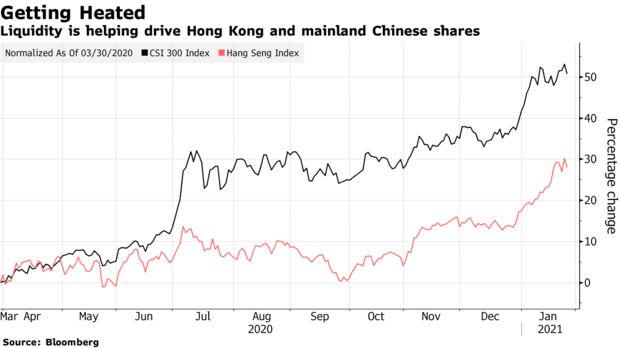
The reaction was particularly brutal in Hong Kong’s stock market, where onshore funds were helping underpin a world-beating rally. Mainland investors bought a net HK$250 billion ($32 billion) worth of Hong Kong stocks this year through Monday, almost 40% of last year’s total, and were buyers again on Tuesday. The Hang Seng Index fell 2.6% from its highest level since June 2018, led by a 7.2% drop in Hong Kong Exchanges & Clearing Ltd. and a 6.3% plunge in Tencent Holdings Ltd.

Liquidity is helping drive Hong Kong and mainland Chinese shares

In mainland markets, a gauge of interbank borrowing costs jumped 36 basis points to 2.78% on Tuesday, the highest level in a year. Futures on Chinese government bonds due in a decade were poised for the biggest decline since September, while the CSI 300 Index of shares in Shanghai and Shenzhen, which has been approaching 2007’s record high, fell 2%.

“The PBOC wants to bring investors out of the euphoria caused by abundant liquidity in December,” says Xing Zhaopeng, an economist at Australia & New Zealand Banking Group. “The PBOC is unlikely to loosen its purse strings at least this week, which will make cross-month liquidity very tight.”

PBOC Governor Yi Gang on Monday said the central bank will seek to support economic growth while limiting risks to the financial system -- a continuation of its existing policy stance. Yi said China’s total debt-to-output ratio climbed to around 280% at the end of last year.

Tencent’s drop came after the stock surged 11% on Monday, its best day since 2011, to approach a trillion-dollar market value. With more than a billion people using its WeChat social-media platform, Tencent is ubiquitous to Chinese investors who have no access to Hong Kong shares of rival Alibaba Group Holding Ltd. through the trading links.

— With assistance by Jeanny Yu